Microbial literacy: a foundation for critical thinking and sustainable future
In an age of misinformation, climate uncertainty, and complex global challenges, fostering critical thinking has never been more important. One powerful yet often overlooked pathway to developing these skills is microbial literacy—an understanding of the microbial world and its profound influence on life, health, and the planet —which of course is the main goal of International Microorganism Day.
Microbial literacy is far more than learning about bacteria, protozoa, fungi, viruses, and archaea. It is about understanding interconnected systems, evaluating evidence, recognizing complexity, and appreciating how scientific knowledge evolves. These are precisely the foundations of critical thinking.
To understand why microbial literacy matters, we must first recognize a simple truth: Earth is, and always has been, a microbial planet. Microbial life emerged approximately 3.5–3.8 billion years ago, long before plants, animals, or humans appeared. For most of Earth’s history, microbes were the only inhabitants of our planet. They colonized every environment, evolved extraordinary metabolic capabilities, and transformed the chemistry of the Earth itself. Most notably, photosynthetic cyanobacteria released oxygen into the atmosphere, contributing to the Great Oxidation Event around 2.4 billion years ago and paving the way for the evolution of complex life.
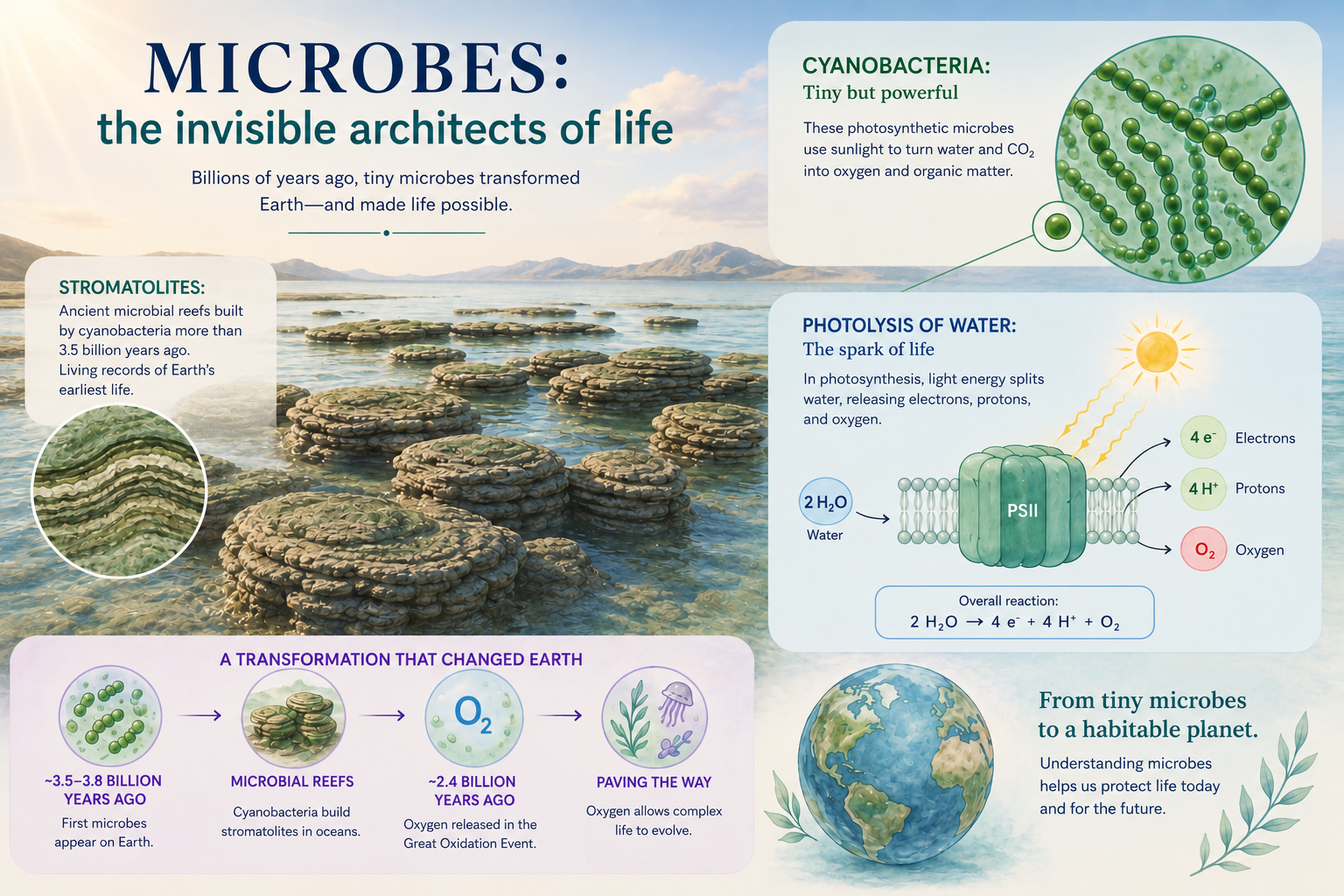
Stromatolites are a major constituent of the fossil record and provide some of the earliest evidence of life on Earth. They are layered sedimentary formations created mainly by cyanobacteria, sulfate-reducing bacteria, and early microorganisms. Stromatolites reached their peak abundance 1.25 billion years ago and played an important role in the oxygenation of Earth’s atmosphere
This deep-time perspective offers a powerful lesson in critical thinking. It challenges the common human-centered view of life and encourages us to examine evidence across vast temporal and spatial scales. Understanding Earth's history through the lens of microbiology reveals that major planetary transformations often result from processes that are invisible to the naked eye. It teaches humility, curiosity, and the importance of questioning assumptions.
Microbes continue to shape the world today. They drive the biogeochemical cycles that recycle carbon, nitrogen, sulfur, and phosphorus; sustain soil fertility; influence climate; purify water; and support the health of humans, animals, and plants. Yet despite their central role, public perception still tends to associate microbes primarily with disease. This disconnect between scientific understanding and societal perception highlights the urgent need for broader microbial literacy. As recent educational initiatives emphasize, microbes are foundational to sustainability, ecosystem balance, agriculture, health, and climate systems, but their importance remains poorly appreciated by much of the public.
Developing microbial literacy can help bridge this gap while strengthening critical thinking skills. Microbiology provides countless opportunities to explore how scientific evidence is gathered, tested, and interpreted. Questions such as "How do we know that microbes influenced the evolution of the Earth’s atmosphere?" or "What role do microbial communities play in climate regulation?" encourage learners to assess data, evaluate competing hypotheses, and distinguish evidence-based conclusions from speculation.
Moreover, microbiology naturally promotes systems thinking. Microbial processes connect individual organisms to ecosystems, local environments to global biogeochemical cycles, and present-day challenges to Earth's evolutionary history. Learning about these connections helps people move beyond simplistic explanations and appreciate the complexity that characterizes real-world problems. Microbes can also provide a link between the distant past and the present, as some can remain dormant for thousands of years in environments such as permafrost or ancient salt deposits, potentially becoming active again when conditions become favorable.
The societal relevance of microbial literacy has become increasingly evident in recent years. The COVID-19 pandemic demonstrated how misunderstanding microbiology can fuel misinformation and undermine public health responses. Similarly, addressing challenges such as climate change, biodiversity loss, food security, and pollution requires a public that can understand and critically evaluate microbiological concepts and evidence. Educational initiatives focused on microbial literacy aim not only to increase knowledge but also to foster informed decision-making, environmental responsibility, and scientific reasoning.
Several educational efforts, including The International Microbial Literacy Initiative (IMiLI) argue that microbiology should become a core component of school curricula. Such efforts recognize that understanding microbial networks and their functions is as important for future generations as understanding economics or geopolitics. Indeed, knowledge of the microbial world is essential for navigating a future shaped by environmental and societal challenges.
Ultimately, microbial literacy is not merely about microbes. It is about learning how to think. By exploring the invisible organisms that built our atmosphere, sustain our ecosystems, and influence our future, learners develop the analytical skills needed to engage with complexity, evaluate evidence, and make informed decisions. In this sense, microbial literacy is both a scientific necessity and a powerful tool for cultivating the critical thinkers that society urgently needs.
Today, on International Microorganism Day, we are glad to promote together our shared goal of helping microbial literacy spread across the world.
Authors:
Juan L. Ramos; CSIC, Estación Experimental del Zaidín, Granada, Spain
Sukanya Lal; Ramjas College, University of Delhi, Delhi, India
Terrence McGenity; University of Essex, Colchester, UK
Patricia Bernal, Faculty of Biology, University of Seville, Sevilla, Spain
Lara Amorim; Faculty of Biology, University of Porto, Porto, Portugal
Rup Lal; Acharya Narendra Dev College, University of Delhi, Delhi, India