Predatory Microbes: Hunters, Hijackers, and Helpers
By Matea Radesic
When we think of predators, lions, wolves, or birds usually come to mind. But predation is not limited to the animal kingdom. Microbes, too, can hunt and manipulate their prey. From bacteria that consume other microbes to fungi that turn ants into zombie-like creatures, microbes use an enormous arsenal of strategies to survive.
Hunting strategies of predatory bacteria
In the bacterial world, there are two main hunting strategies. The first strategy is epibiotic predation, where the predator attaches to the outside of the prey and consumes it externally. Solitary hunters latch onto prey cells and extract their internal contents. Meanwhile, cooperative hunters work in groups, releasing enzymes and metabolites to dismantle prey collectively before sharing the nutrients. In the second strategy, called endobiotic predation, the predator invades the prey’s periplasm or cytoplasm, growing inside the host until it consumes it completely.
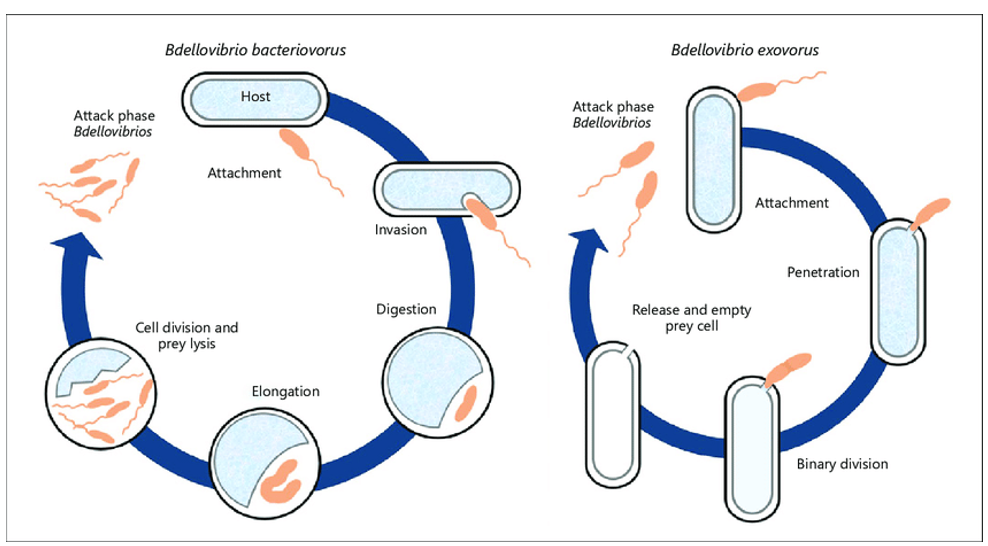
Life cycle of Bdellovibrio bacteriovorus and Bdellovibrio exovorus, representing endobiotic and epibiotic lifestyles, respectively. By Bauer & Forchhammer (2021)
Invading bacterial predator
Bdellovibrio bacteriovorus is the best-studied example of endobiotic bacterial predators, famous for its ability to parasitize Gram-negative bacteria. It begins its hunt as a highly motile, flagellated cell searching for prey. Upon contact, it attaches to the prey’s outer membrane and enters the periplasm. There, it releases a suite of enzymes that degrade the prey’s cell wall and cytoplasm, releasing macromolecules to feed on. Inside the periplasm, Bdellovibrio bacteriovorus cells divide until the host cell bursts, and the young prey cells continue the cycle. This microbe has a great potential as a living antibiotic, targeting antibiotic-resistant pathogens by exploiting essential features of their cell walls for attachment and invasion.
Besides Bdellovibrio bacteriovorus, two of the most striking bacterial predators are Vampirovibrio and Vampirococcus, both named for their vampiric feeding strategy. These epibiotic bacteria attach themselves tightly to the outer surface of their prey, often photosynthetic microbes such as cyanobacteria, and siphon out nutrients until the host cell collapses.
Microbes as masters of manipulation
Besides bacteria, there are other microbes that excel at host manipulation. Notoriously known for inspiring the post-apocalyptic video game and TV series The Last of Us, Ophiocordyceps unilateralis proudly holds the nickname of “zombie ant fungus.” This parasite fungus infects carpenter ants with spores that penetrate the exoskeleton through a combination of enzymes and mechanical force. Once inside, the fungus secretes effector molecules that alter the host’s nervous system. The ant begins acting strangely: it becomes more active in daylight, isolates from the colony, and climbs vegetation before biting into a leaf or twig. There it eventually dies, and the fungus produces a fruiting body from the carcass that disperses spores to infect new hosts.
Not all host-manipulating microbes inspire video games, yet some have equally dramatic effects. An example is Toxoplasma gondii, a protozoan parasite which causes rodents a fatal attraction to cats. This parasite can reproduce only in the intestines of cats, where it undergoes sexual reproduction and is then spread in the environment as oocysts in the cat’s feces, where it infects intermediate hosts, including rodents. There, it forms intracellular cysts throughout the host's body including the brain, showing a striking affinity for regions like the amygdala, which regulates fear and sexual behavior. Mice infected with Toxoplasmagondii have a drastically altered behavior: they lose their aversion to cats and are more likely to be preyed upon, which helps complete the parasite’s life cycle.
Biocontrol and therapeutic potential of predatory microbes
While some predatory and parasitic microbes bring disease, they may hold solutions to pressing global challenges. Predatory bacteria like Bdellovibrio bacteriovorus and Micavibrio aeruginosavorus have shown promise as alternatives to conventional antibiotics. Their ability to attack multi-drug resistant pathogens and biofilms that resist standard treatments is being investigated, which could aid with the ongoing antibiotic resistance crisis. Moreover, predatory microbes may also help reduce reliance on chemical pesticides and antibiotics in food production. Bdellovibriobacteriovorus has already been shown to suppress crop pathogens affecting soybeans, potatoes, and mushrooms. In aquaculture, Halobacteriovorax sp. has been tested against Vibrio sp. species, a common pathogen of fish and shellfish, providing a sustainable alternative to antibiotics that pollute water systems.
Conclusion
While some predatory and parasitic microbes bring disease, they may hold solutions to pressing global challenges. Predatory bacteria like Bdellovibrio bacteriovorus and Micavibrio aeruginosavorus have shown promise as alternatives to conventional antibiotics. Their ability to attack multi-drug resistant pathogens and biofilms that resist standard treatments is being investigated, which could aid with the ongoing antibiotic resistance crisis. Moreover, predatory microbes may also help reduce reliance on chemical pesticides and antibiotics in food production. Bdellovibriobacteriovorus has already been shown to suppress crop pathogens affecting soybeans, potatoes, and mushrooms. In aquaculture, Halobacteriovorax sp. has been tested against Vibrio sp. species, a common pathogen of fish and shellfish, providing a sustainable alternative to antibiotics that pollute water systems.
About the author:
Matea Radešić is a doctoral student at the University of Helsinki, Finland. She is currently studying the biotechnological potential of tRNA modifications in recombinant protein translation. Although her present work is mainly focused on molecular biology, her background lies in microbiology and food science.